
MSU hosts international symposium on advanced vehicle technology
Contact: James Carskadon
STARKVILLE, Miss.—Showcasing its groundbreaking work in autonomous vehicles, Mississippi State University hosted the 7th International Symposium on Advanced Vehicle Technology earlier this month.
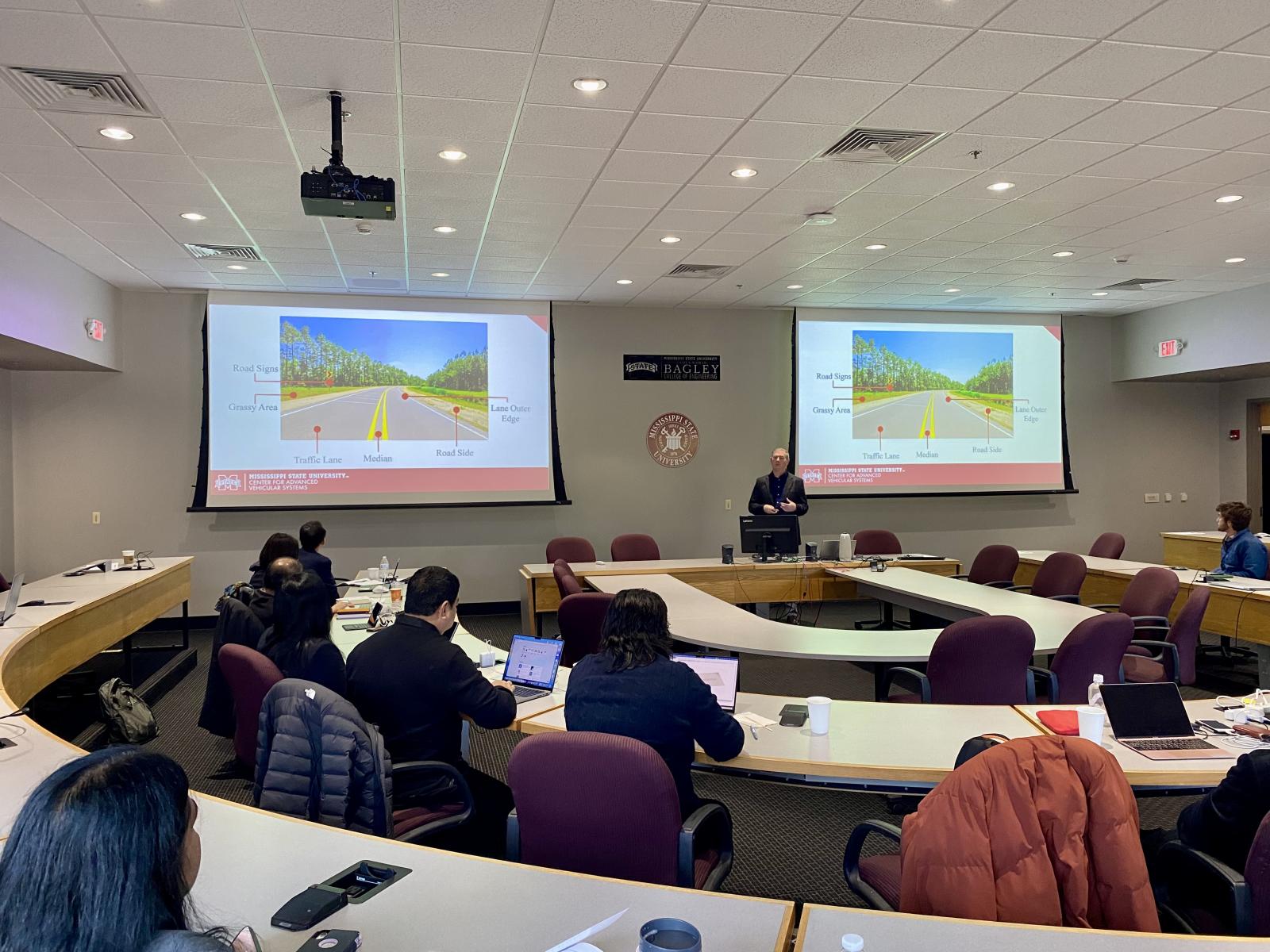
The symposium brought together researchers from around the world to share their latest work driving the future of vehicles. The event at MSU’s Center for Advanced Vehicular Systems included sessions on modeling and simulation, vehicle sensors, human-AI interactions, next generation traffic safety, lightweight materials and batteries, nature-inspired intelligence and more.
“This is an exciting time as new technologies allow us to reimagine how we interact with vehicles and how our vehicles interact with the world around them,” said CAVS Associate Director for Advanced Vehicle Systems Daniel Carruth. “This symposium brings together experts from across the globe, all working to solve different mobility challenges. We are proud to host this international gathering on campus.”
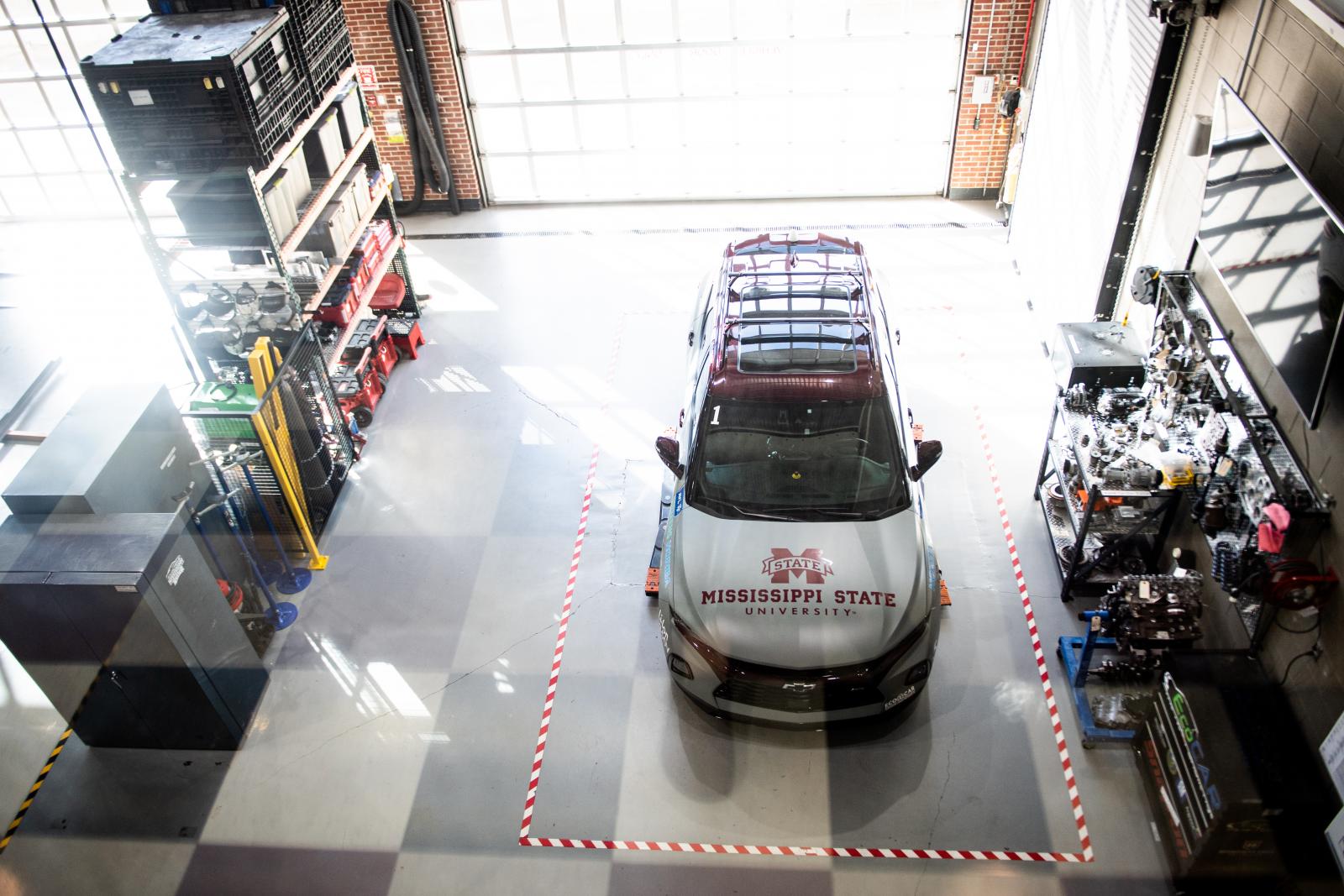
The symposium included tours of CAVS and the center’s 55-acre autonomous vehicle proving ground. Renovated this year, the proving ground allows researchers to test how autonomous vehicles and the software powering them operate in an off-road environment. The line of research has several military applications and has led to collaborations with the U.S. Army Engineer Research and Development Center and the North Atlantic Treaty Organization.
Christopher Goodin, CAVS associate research professor, highlighted the development of the MSU Autonomous Vehicle Simulator, or MAVS. The software enables the simulation of off-road, autonomous ground vehicles. It can be scaled using high performance computing, allowing for thousands of concurrent simulated experiments.
Goodin noted that MAVS addresses several use cases, such as detecting obstacles hidden by dense vegetation, optimizing sensor placement, and finding paths. It also can be used to simulate teaming of multiple vehicles in an off-road environment.
“This lets us see decentralized control of a group of vehicles in off-road environments,” Goodin said. “This allows us to simulate thousands of variables, which would be cost prohibitive to replicate in a real-world environment.”
Carruth noted that MSU is engaging students at K-12 and collegiate levels to help prepare a workforce that can both design and operate the autonomous vehicles that will play an increasing role in key industries such as agriculture and manufacturing. The MSU-developed NATURE (Navigating All Terrains Using Robotic Exploration) open-source software allows users to access a full suite of algorithms designed for autonomous off-road navigation.
“We want a software stack that shows students how these can work to fulfill real-world needs, such as a farmer needing to navigate a dirt road or utilities needing to inspect safety equipment,” Carruth said.
The organizing committee for the international symposium included representatives from MSU, Japan’s Nihon University and Nagoya University, Thailand’s Rajamangala University of Technology Thanyaburi, and the Illinois Institute of Technology.
For more on CAVS, visit www.cavs.msstate.edu.
Mississippi State University is taking care of what matters. Learn more at www.msstate.edu.