
Mississippi Cyber Initiative summit at MSU spotlights rapid technological advances in digital forensics
Contact: James Carskadon
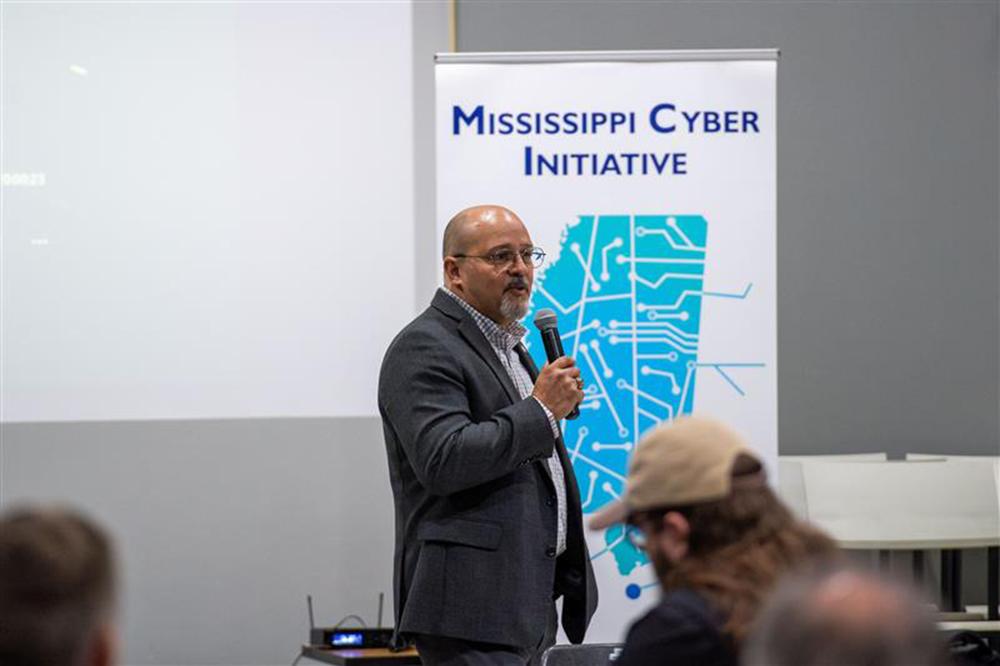
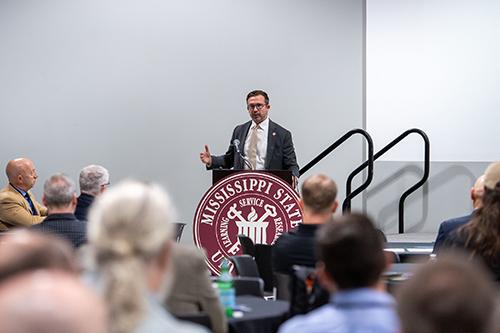
STARKVILLE, Miss.—Leaders from law enforcement, academia and cyber forensics gathered recently at Mississippi State University for the Mississippi Cyber Initiative Summit showcasing the fast-evolving world of cybercrimes and the digital forensics tools used by law enforcement.
The two-day summit brought together investigators, digital forensics specialists, federal partners and technology innovators to examine how emerging tools are reshaping how crimes in cyberspace are detected, analyzed and solved.
“This year’s first MCI event provides a focus on the technological forensics that reflect the reality facing every agency in the state of Mississippi,” said MCI Director Martin Rivera. “Criminal activity resides in cyberspace, and our investigative capabilities must move with it.”
MCI launched a Digital Forensics Lab in 2022 after the need for additional support for digital investigations was identified. Now outfitted with high-tech equipment, the lab supports more than 50 law enforcement agencies with expertise and resources to enhance investigations.
State and federal leaders highlighted the unprecedented surge in cybercrimes and the evidence generated across nearly every category of lawbreaking, such as petty thefts, drug trafficking, critical infrastructure intrusions, financial fraud, identity fraud, cyberstalking, sextortion, hate crimes, child solicitation and exploitation, and human trafficking.
“Working together is the key to staying ahead of cybercrimes. Organizations must join forces to make the most of information gathering and technical resources,” said Robert Eickhoff, special agent in charge for the Federal Bureau of Investigation’s Jackson Office.
Investigators now routinely rely on cloud-based data, mobile-device extractions, blockchain tracing and AI-driven analytics to reconstruct events and identify offenders.
“Every case now has a digital footprint. We need investigators who can follow that trail, whether it leads to a mobile device, a server farm or a blockchain ledger,” said Shawn Wolfe director of the Cybercrimes Unit in the Mississippi Attorney General’s Office.
Accompanied by a technology showcase, speaking engagements throughout the summit demonstrated how rapidly the field is advancing. Experts walked attendees through real-world cybercrime case studies involving mobile devices, encrypted devices, cross-platform data recovery, forensics methods using cyber information such as IP and MAC addresses, autonomous systems, geo-spatial data and the use of artificial intelligence to detect manipulated media and synthetic imagery.
The MCI summit serves as a platform for strengthening partnerships across jurisdictions. Agencies emphasized the importance of shared intelligence, coordinated response frameworks and standardized forensic practices as cybercrime grows more complex, crossing state and national borders.
As cyber threats accelerate, the MCI summit will continue to focus on technological forensics, which will only grow. Mississippi’s universities and training centers are expanding programs in cyber forensics, incident response, and investigative technology to meet rising demand from state and federal agencies.
“The cyber threats are evolving, but so are the tools, the talent and the partnerships. That’s why this summit is so important in ensuring Mississippi stays ahead of the technology curve,” said Ed Carter, resident agent in charge with the U.S. Secret Service.
The Mississippi Cyber Initiative was launched in 2021 to drive collaboration and innovation in cybersecurity among academic, state, federal, defense and private industry partners. Headquartered on the Mississippi Gulf Coast, construction is currently underway on a 100,000-square-foot building adjacent to Keesler Air Force Base that will serve as MCI’s headquarters. For more information, visit www.mscyberinitiative.org.
Mississippi State University is taking care of what matters. Learn more at www.msstate.edu.