
Ahead of ‘Shark Week’: How MSU graduate students are taking a bite out of shark research
Contact: Meg Henderson
STARKVILLE, Miss.—As Discovery Channel’s “Shark Week” enters its 38th season, public fascination with apex predators continues to rise. But while television audiences tune in for the drama, two Mississippi State graduate students are part of the network of scientists who help provide necessary data behind the public’s often-varying opinions on sharks.
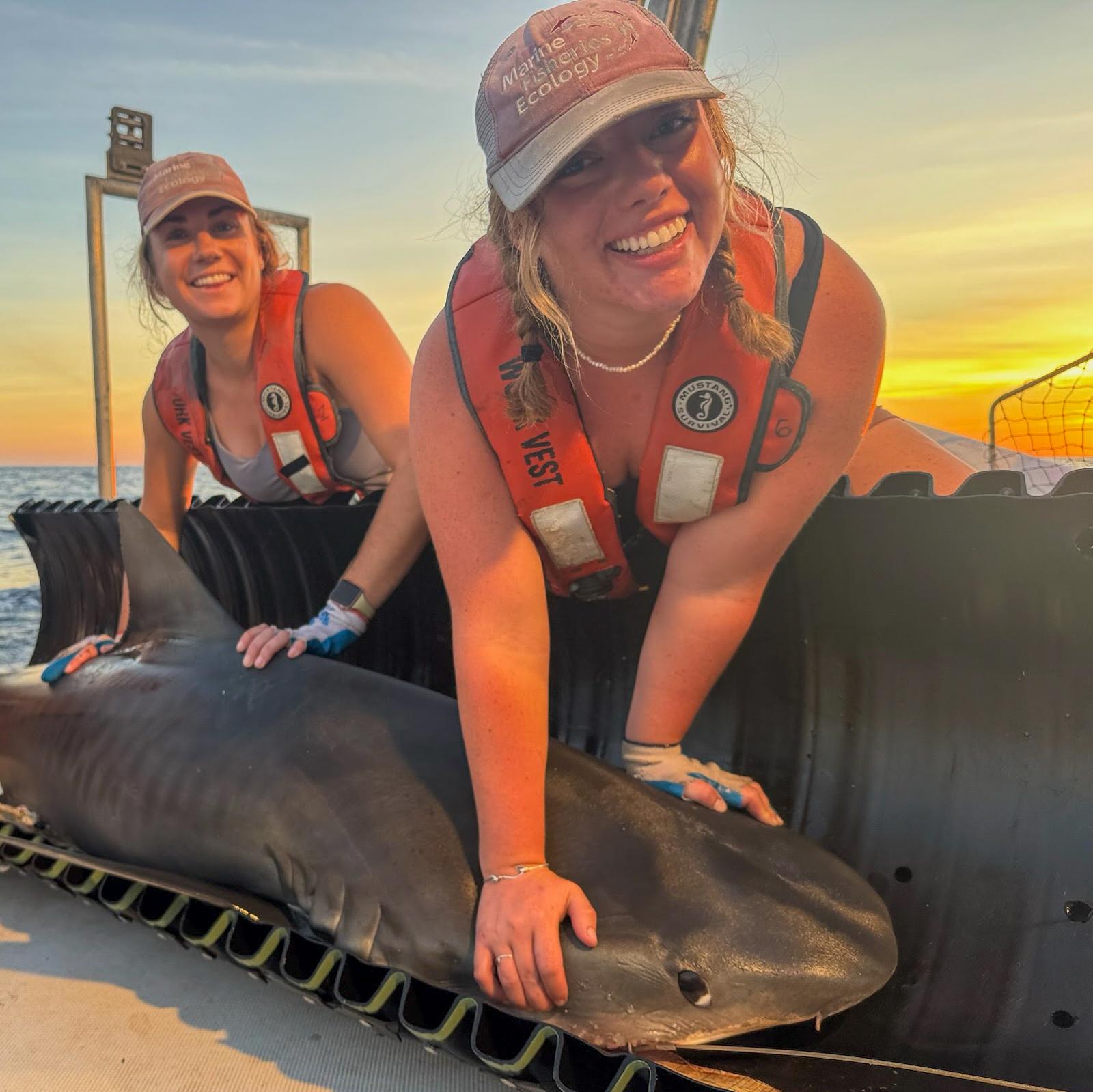
Alena Anderson and Danielle McAree, graduate researchers in MSU’s College of Forest Resources, are contributing to long-term scientific studies that plumb the depths of shark biology and behavior, a field that inspires equal parts curiosity and fear.
In 2021, Anderson and McAree moved to Mississippi from opposite ends of the country—California and Massachusetts, respectively—for internships in the Marine Fisheries Ecology program at MSU’s Coastal Research and Extension Center. The following year, both enrolled in the master’s program within the Department of Wildlife, Fisheries and Aquaculture. Their shared passion for sharks forged a strong professional partnership and lasting friendship.
“I’m glad I took the internship. I love the Coast and the opportunities that have come from that move,” Anderson said. “Finding the balance between academic studies and professional work was challenging, but having professional experience in Extension strengthened our communication skills.”
Their master’s thesis projects contributed to the program’s two-decade mission of evaluating fish population changes along the north-central Gulf Coast and better understanding issues affecting ecosystem management and commercial and recreational fishing.
Focusing on age and growth dynamics, both researchers investigated maximum longevity, reproductive maturity and growth rates—data that help fishery managers set minimum size limits and harvest regulations. Anderson studied blacknose sharks, while McAree focused on tiger sharks. The two spent many hours on the water capturing, measuring, tagging and releasing sharks to collect data on their age and movements.
Back on shore, they analyzed samples from the laboratory’s extensive repository, analyzing shark vertebrae to determine age.
“We measure growth through the shark’s vertebrae, which we can think about like tree rings in that they represent growth over time,” McAree said. “During summer, they grow faster and lay down wider, translucent bands, and in winter, growth slows, and the bands become narrower and more opaque.”
Comparing band counts to overall length allows scientists to construct growth curves. Anderson’s research involved comparing modern blacknose shark samples with data collected in the 1990s.
“One of the most interesting findings is blacknose sharks appear to be growing significantly faster now than they did 30 years ago,” she said.
In addition to their research, Anderson and McAree served as full-time MSU Extension program associates. McAree explained education is crucial when navigating conflicting public opinions—balancing the perspectives of anglers who perceive shark overpopulation with conservationists advocating for total protection.
“As fisheries scientists, we believe sustainable harvest can be appropriate when regulations support healthy populations,” she said. “We try to avoid both extremes and communicate the importance of balance.”
Anderson graduated in May and now serves as a full-time Extension associate, and McAree is set to graduate in August. Marcus Drymon, associate Extension professor and Marine Fisheries Ecology program director, praised their work and dedication.
“It has been a distinct pleasure watching them grow from inexperienced interns into professionals through the graduate school process and their jobs,” he said. “They are a critical part of this program, and I’m extraordinarily proud of them.”
MSU’s College of Forest Resources is available online at www.cfr.msstate.edu. For more on MSU’s Marine Fisheries Ecology, visit www.msucoastal.com/marine-fisheries.
Mississippi State University is taking care of what matters. Learn more at www.msstate.edu.