
MSU’s Imaginarium expands STEAM learning research through collaborative NSF grant
Contact: Bethany Shipp
STARKVILLE, Miss.—Mississippi State’s Imaginarium Creativity and STEAM Discovery Center is collaborating with the University of Alabama on a nearly $750,000 National Science Foundation-funded project that explores how K-8 learners engage with hands-on STEM experiences in informal learning environments. STEAM is an acronym for science, technology, engineering, art and math.
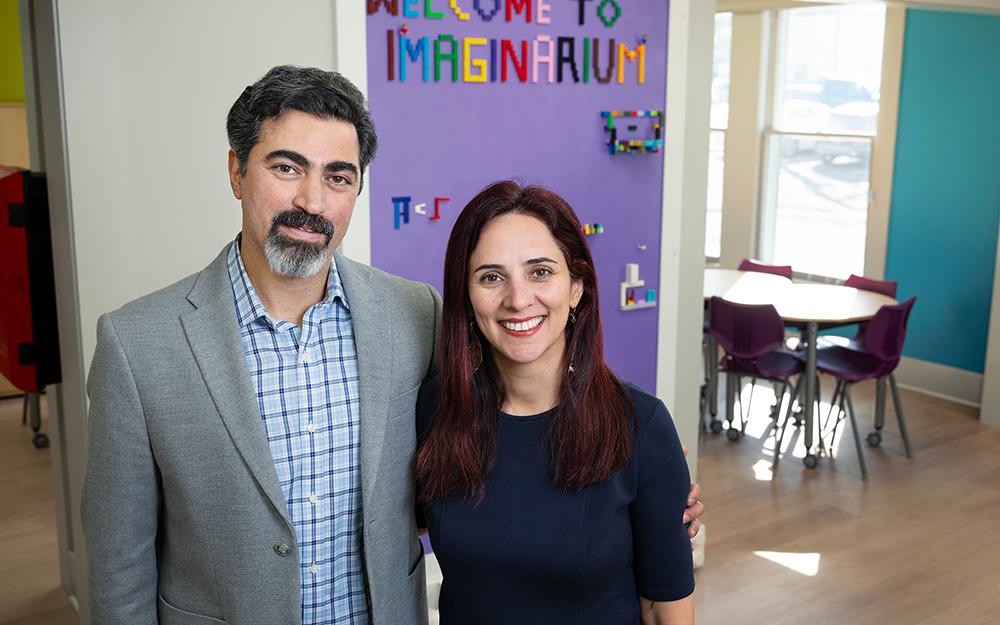
Located on MSU’s campus, the Imaginarium is co-directed by co-founders Mehdi Garemani and Sareh Karami, faculty members in the College of Education’s Department of Counseling, Higher Education Leadership, Educational Psychology, and Foundations.
The three-year NSF project Understanding Learner Engagement in Informal STEM Learning Environments brings together expertise in educational psychology, learning sciences, artificial intelligence and computer vision. Garemani serves as a co-principal investigator, while Karami serves as senior/key personnel. The project is led by Noorbakhsh Amiri Golilarz, principal investigator and director of UA’s Bioinspired Robotics, AI, Imaging and Neurocognitive Systems, or BRAINS, Laboratory, with UA’s Shahram Rahimi serving as a co-principal investigator.
The interdisciplinary team will study how children engage behaviorally, emotionally, cognitively and socially as they explore hands-on STEM exhibits and activities. By connecting the Imaginarium’s expertise in educational psychology, informal learning and community engagement with the BRAINS Lab’s research in AI, computer vision and intelligent systems, the partnership creates opportunities to examine how emerging technologies can help educators better understand learner engagement and ultimately support more personalized, developmentally appropriate and meaningful STEM learning processes.
“This project represents exactly what we hoped the Imaginarium could become: A place where joyful, hands-on learning and rigorous educational research inform one another,” Garemani said. “By studying how children engage, collaborate, persist and problem-solve in authentic learning environments, we have a chance to better understand learning as it is actually happening and use those insights to design even more meaningful and responsive STEAM experiences.”
Launched in fall 2025, the Imaginarium is an expansion of the Imaginarium Express, a traveling makerspace initiated by Garemani and Karami in 2023. While the mobile unit continues to serve rural communities, the permanent center offers immersive experiences for field trips, camps, birthday parties and more.
“One of the most exciting aspects of this project is that we can study engagement in a setting where learning happens naturally through curiosity, play, experimentation, collaboration and even productive failure,” Karami said. “Our goal is not simply to use new technology, but to use what we learn to create more responsive and equitable experiences that help children see themselves as capable thinkers, creators and problem-solvers.”
MSU’s College of Education, home of the Imaginarium and the Department of Counseling, Higher Education Leadership, Educational Psychology, and Foundations, also includes four additional academic departments, a division of education, one research unit and numerous service units.
Mississippi State University is taking care of what matters.