
MSU engineering college, CAVS Extension work with industry partners to introduce Integrated Logistics Support training on the Gulf Coast
Contact: James Carskadon
STARKVILLE, Miss.—Mississippi State manufacturing experts and students are leading a collaboration with Bollinger Shipyards and technical services firm CHAND to strengthen workforce training in the shipbuilding industry through the development of an Integrated Logistics Support, or ILS, curriculum.
The partnership began when CHAND Executive Vice President Cindie Roussel recognized the growing need for training within the industry. ILS is a unified technical analysis and management discipline that ensures naval ships, aircraft and weapon systems can be effectively operated and maintained throughout their entire life cycle.
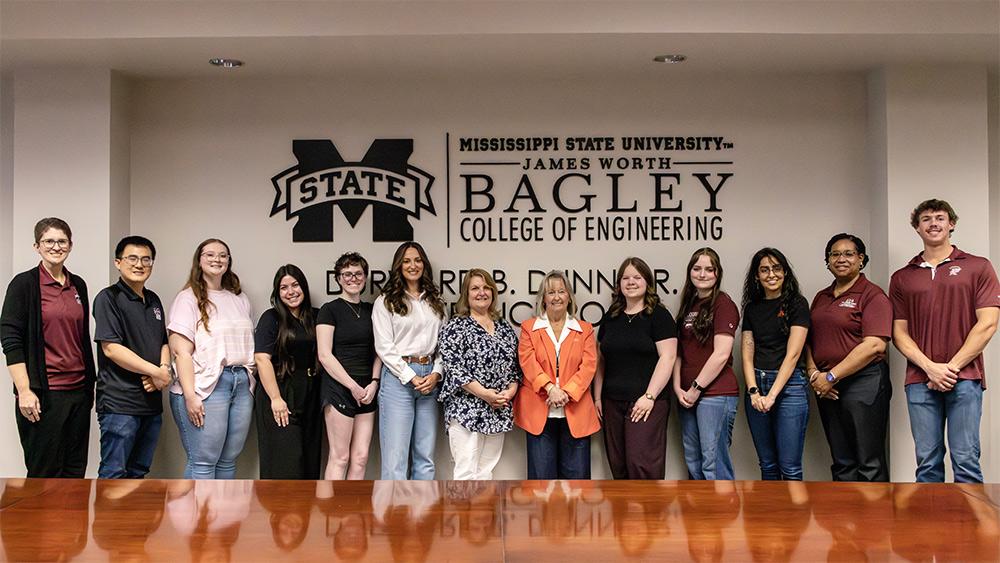
“The complexities of Integrated Logistics Support are not captured in one concise training course,” Roussel said. “We partnered with MSU to transpose decades of knowledge, military standards, common contract requirements and undocumented government expectations into a formalized training course that our growing industry needs.”
Roussel turned to MSU’s Center for Advanced Vehicular Systems-Extension and the Bagley College of Engineering to develop an ILS training curriculum.
“Working alongside the MSU students enabled us to turn years of experience into a structured training program that fills a critical gap,” Roussel said. “This training will open doors to rewarding career opportunities while building the essential skills needed to strengthen mission readiness and crew preparedness for these ships.”
The state’s shipbuilding industry on the coast plays a critical role in supporting U.S. defense needs. Through this collaboration, MSU students, faculty and staff helped translate industry expertise into structured training that supports both workforce development and national defense. Funded with support from the state’s office for workforce development AccelerateMS, the training is expected to benefit the entire region by growing the number of professionals with working ILS knowledge.
CAVS Extension Director Tonya McCall said the collaboration addresses workforce challenges facing shipbuilding and other manufacturing sectors, where experienced workers are retiring and institutional knowledge must be transferred efficiently.
“This project is about upskilling people for real‑world roles,” she said. “Having students involved was critical because their perspective closely aligns with many employees entering the industry, and their contributions strengthened the training itself.”
Industrial engineering senior Jane Strawderman said the project gave students exposure to the scale and complexity of real‑world logistics and engineering.
“As students, we don’t typically get to work with companies, especially on projects of this size,” she said. “This experience showed us what our jobs will actually look like when we start taking large amounts of information, breaking it down and understanding it well enough to teach it to others.”
This curriculum includes multiple training modules introducing foundational ILS concepts, along with a train‑the‑trainer component designed to help CHAND sustain and expand the program internally.
Beyond technical concepts, the collaboration challenged students to develop professional skills that are difficult to replicate in a classroom setting. Lesley Strawderman, International Paper Chair and professor in MSU’s Department of Industrial and Systems Engineering, said students learned that managing a real‑world project involves more than tools and templates.
“This wasn’t a neat, self‑contained assignment,” said Lesley, who worked with her daughter Jane on the project. “Students had to manage a large, integrated project with real stakeholders, evolving expectations and real consequences. They learned how to work together with grace and professionalism, and they saw that project management is more than just a tidy Gantt chart—it’s about communication, judgment and coordination.”
While CHAND operates under the Bollinger Shipyards umbrella, the company supports multiple shipyards throughout the region, including organizations often considered competitors within the industry. Its Boot Camp aims to strengthen the overall workforce pipeline by preparing trained, knowledgeable employees who can contribute across the shipbuilding sector.
“Building a strong maritime workforce requires industry, education, and training partners to work together toward a common goal,” said Ben Bordelon, Bollinger Shipyards president and CEO. “Programs like the Integrated Logistics Support Boot Camp are critical to developing the next generation of skilled professionals and creating long-term career pathways for students across the Gulf Coast. By investing in workforce development collaboratively, we can strengthen the entire maritime industrial base and help meet the growing demands of the industry.”
Mississippi State University is taking care of what matters. Learn more at www.msstate.edu.